Loading...
Injury prevention
Practice your landings, increase load gradually, protect an ankle you've already sprained, and get help when pain changes how you move.
Practice your landings, increase load gradually, protect an ankle you've already sprained, and get help when pain changes how you move.
Some injuries are bad luck, but the common ones in volleyball follow predictable patterns. Ankle sprains happen at the net. Jumper's knee builds up from jump load. Shoulder and low back pain build up from repeated hitting and serving. A few weekly habits lower the risk of each one.
Injuries come in two types. Acute injuries happen in a moment, like a rolled ankle or a jammed finger. Overuse injuries build over weeks of repeated load, like a sore knee tendon after thousands of jumps.
Across volleyball injury research, the lower body accounts for 50 to 60% of injuries. In world-class players, ankle injuries were the most common for every position except libero, and nearly half of them came from contact with another player. The knee was the second most injured area and the top source of overuse injuries. Concussions made up a larger share than you might expect in a sport without tackling[1].
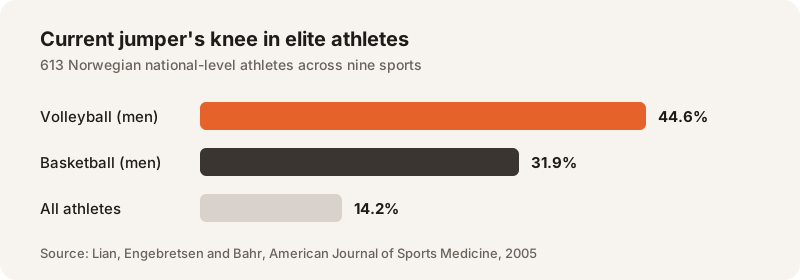
The knee problem is usually jumper's knee (patellar tendinopathy), pain in the tendon just below the kneecap. About a quarter of volleyball players have it, one of the highest rates in any sport[2]. Among elite Norwegian men, it was close to half[3].
Overuse problems are easy to ignore because players keep playing through them. Over three seasons of elite men's volleyball, 31% of players reported knee problems in an average week, and 93% had some complaint over a season. Players who started the season with knee pain did much worse: 42% of them had knee problems in an average week, compared with 8% of players who started pain-free[4]. Deal with preseason pain before the season starts.
Most volleyball ankle sprains happen at the net. In video of ankle injuries at major international events, most happened while blocking, usually when the blocker landed on the foot of an attacker who had come down on or across the center line[5].
A clinical guideline on ankle sprains found that a brace or tape cuts the risk of a repeat sprain by about 70% and lowers the risk of a first sprain by about 30%, with brace and tape working about equally. Balance training after a sprain also reduces repeat sprains, though it hasn't been shown to prevent a first one[6].
One caution on balance work: in a volleyball study of 116 teams, players with a history of knee overuse injuries had more knee problems during a balance board program[7]. If that's you, check with a physio before you start.
No single cause explains jumper's knee. A review of 31 studies found limited evidence for several, including more jump training, more sets played per week, and less ankle bend[8]. The players who jump the most and the highest are often the most at risk, so focus on what you can control: jump load, leg strength, and ankle range.
The best-tested shoulder program comes from handball, another overhead sport. A warm-up with external rotation strength, shoulder blade strength, and mobility, done 3 times a week, cut shoulder problems by 28% in 660 elite players[9].
Low back pain is common in volleyball. In the elite men's study above, 21% of players reported it in an average week. No volleyball study has found a proven way to prevent it, so these steps follow the same logic as the rest of this guide:
Get your back checked if the pain lasts more than a couple of weeks, gets worse when you arch backward, or wakes you at night. Stress injuries to the spine (spondylolysis) occur in volleyball and need a proper diagnosis. Growing players should get checked sooner.
Once a week, rate your knee, shoulder, and back. For each one, note whether it limited how much you trained, how well you played, and how much it hurt. Two weeks of rising pain in the same spot means it's time to talk to your coach and a physio.
Track your training load too. The recovery guide shows how to log session effort and jump counts. Watch for big increases from one week to the next.
| Day | Prevention work |
|---|---|
| Mon | Lift (strength guide), shoulder warm-up |
| Tue | Practice: full warm-up with balance and shoulder work |
| Wed | Easy day: mobility routine, balance drills |
| Thu | Lift, shoulder warm-up |
| Fri | Practice: full warm-up, count jumps |
| Sun | Weekly pain check (knee, shoulder, back) |
See a physio, athletic trainer, or doctor if you have:
This guide is general information and can't diagnose an injury. Young players and anyone coming back from an injury should be cleared by a professional before returning to full play.