Loading...
Warm-up
Get warm, loosen your joints, switch on your shoulders and legs, then finish with a few sharp jumps before the first ball.
Get warm, loosen your joints, switch on your shoulders and legs, then finish with a few sharp jumps before the first ball.
A good warm-up gets you ready to jump, move, and swing at full speed from the first point, and volleyball warm-up programs have been linked to fewer injuries. The routine below takes about 15 minutes.
The routine follows the RAMP model many coaches use: raise your body temperature, activate key muscles, mobilize your joints, then prime yourself for full effort with a few explosive reps. (The P stands for potentiate, the technical word for that priming.)
A review of 13 volleyball studies found that dynamic, resisted, and volleyball-specific warm-ups gave the most consistent gains in jumping, agility, and reaction time. Static stretching and foam rolling added little[1].
Short static stretches are fine if they help you feel loose. Holds of 60 seconds or less per muscle, inside a full warm-up, cost only about 1 to 2% in strength and power. Longer holds cost more[2], so save them for the mobility routine after practice.
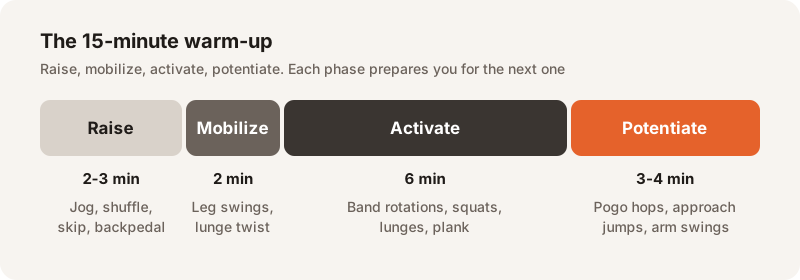
| Phase | Time | What to do |
|---|---|---|
| Raise | 2-3 min | Light jog, side shuffles, backpedal, skips, carioca |
| Mobilize | 2 min | Leg swings (front-back and side-side), walking lunge with a twist, arm circles, open-the-gate hips |
| Activate: shoulders | 3 min | Band external rotations (elbow at side, then arm up at 90°), band pull-aparts, scap push-ups |
| Activate: legs and trunk | 3 min | Bodyweight squats, lateral lunges, single-leg balance (eyes closed if it's easy), front plank |
| Prime | 3-4 min | Pogo hops, 3-4 approach jumps that get faster each time, a few quick shuffles to a stop, then easy-to-hard arm swings with a partner |
Then move into your ball warm-up (passing, setting, hitting lines) and build gradually to full speed.
Keep the priming phase short. A few sharp jumps at the end are plenty, and you should finish feeling ready rather than tired.
In a study of more than 500 youth players, teams using the VolleyVeilig warm-up program had fewer acute injuries and fewer arm and shoulder injuries, and their injuries were less severe. The overall drop of about 30% wasn't statistically certain, and only 44% of teams did the full program as intended[3]. In recreational players, a shoulder-focused warm-up done twice a week cut injuries, with a clear drop in shoulder injuries among the men[4].
Supervision matters too. Across 44 trials in many sports, prevention programs cut injuries by about a third when a coach supervised them, and had no clear effect when players did them alone[5]. Do it as a team, with someone running it. The injury prevention guide covers the rest of the week.
Before a match, keep the warm-up sharp and stop short of tiring yourself out. Pre-match warm-ups include a fair amount of jumping, so count them as part of your day's load.
If you've been sitting, warm up again. Across 20 team-sport studies, a short re-warm-up after a break improved jumping, sprinting, and agility compared with staying seated[6]. Before you sub in, or during a long break between sets, do 1 to 2 minutes of shuffles, a few pogo hops, and a couple of arm swings.