Loading...
Plyometrics
Learn to land first, move from low to high intensity, and count your foot contacts, practice jumps included.
Learn to land first, move from low to high intensity, and count your foot contacts, practice jumps included.
Plyometrics are quick jump-and-rebound drills. They make you jump higher, and they also train you to land well, move sideways, and react fast. Volleyball practice already includes a lot of jumping, so the aim is a small, high-quality dose on top of it.
The vertical jump guide covers your approach and arm swing. This guide covers landing, progression, and how many jumps to do.
When you dip before a jump, your muscles and tendons stretch, then recoil like a rubber band to push you off the ground. Plyometrics train that recoil. In volleyball players, plyometric training improves jump height for men and women of all ages[1].
Two terms come up in this guide:
Most volleyball ankle sprains happen on landings at the net, often on another player's foot. Landing well is a skill you can practice. Across 18 studies and more than 25,000 athletes, injury prevention programs with landing, balance, and strength drills cut ACL tears by more than half[2]. Most of that research is in soccer and handball, and the programs worked best when players did them consistently.
Blocking needs extra care. In a volleyball study, players who leaned their arms and trunk sideways on a block landed with less knee bend and more inward stress on the knee[3].
A good landing:
Start with these drills:
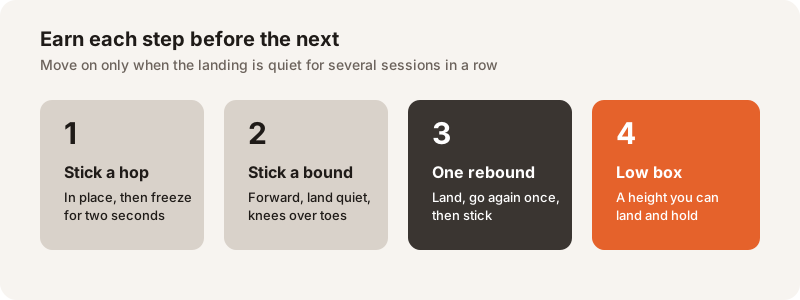
"Stick" means you hold the landing, balanced, for 2 seconds.
Start at Level 1, even if you've done a lot of jumping before.
| Level | Examples | Move up when |
|---|---|---|
| 1 (low) | Pogo hops, line hops (front-back and side-side), squat jumps, snap-downs | Every landing is quiet and controlled |
| 2 (moderate) | Box jumps, lateral bounds with a stick, split-squat jumps, tuck jumps | You can do them fresh with clean landings |
| 3 (high) | Drop jumps from a low box, continuous lateral bounds, single-leg hops | Only after weeks of solid Level 2 work |
This low, moderate, high progression follows clinical guidance on plyometrics, which starts with two-foot drills[4]. The move-up rules are coaching judgment, so let your landings decide when you're ready.
Elite volleyball players already take 1,000 to 4,000 jumps a week in practices and matches[5], so extra plyometrics add up fast. Keep each session to 3 to 6 sets of 2 to 5 reps, using 2 or 3 exercises, and stay under these totals:
| Experience | Contacts per session (plyometric drills only) |
|---|---|
| Beginner | 80 to 100 |
| Intermediate | 100 to 120 |
| Advanced | 120 to 140 |
Treat these as upper limits. Leave 48 to 72 hours between hard plyometric sessions.
Doing more doesn't help much. In volleyball studies, programs under 2,000 total jumps did about as well as bigger ones, and 2 sessions a week did about as well as 3 or more.
Count court jumps too. Across a season, middle blockers jumped the most and setters the least[6], so a middle and a setter shouldn't do the same plyometric session. Counting is mostly about avoiding sudden increases in load.
A lot of volleyball movement is sideways or backward, and many takeoffs and landings happen on one leg. Single-leg plyometrics improve single-leg jumps, sprinting, and change of direction more, while two-leg plyometrics improve two-leg jumps more[7]. Do both.
Once your landings are solid, make the drills respond to something. A partner points left or right and you bound that way and stick it. Or a coach tosses a ball and you shuffle, plant, and jump. A cue adds no extra contacts and makes the drill more like a game. The agility guide covers reaction training in more detail.
Always warm up first. The warm-up guide has a routine.
| Weeks | Focus | Example | Approx. contacts |
|---|---|---|---|
| 1-2 | Landings + Level 1 | Snap-downs 3 x 5, line hops 3 x 10, lateral hop and stick 3 x 4 per side | 70 to 80 |
| 3-5 | Level 2 | Box jumps 4 x 4, lateral bound and stick 3 x 4 per side, split-squat jumps 3 x 4 per leg | 60 to 70 |
| 6-8 | Add Level 3 | Drop jumps (low box) 4 x 4, continuous lateral bounds 3 x 6, single-leg hop and stick 3 x 3 per leg | 50 to 60 |
Contacts drop as the drills get harder, because each high-intensity rep loads your legs more.