Loading...
Agility
Learn to brake, drill the footwork volleyball uses, then add a cue so you have to read the play before you move.
Learn to brake, drill the footwork volleyball uses, then add a cue so you have to read the play before you move.
Agility in volleyball is how quickly you read the play, brake, turn, and reach a ball when you don't know where it's going until the last moment. Most of it happens in a step or two, sideways or backward, often right after you land.
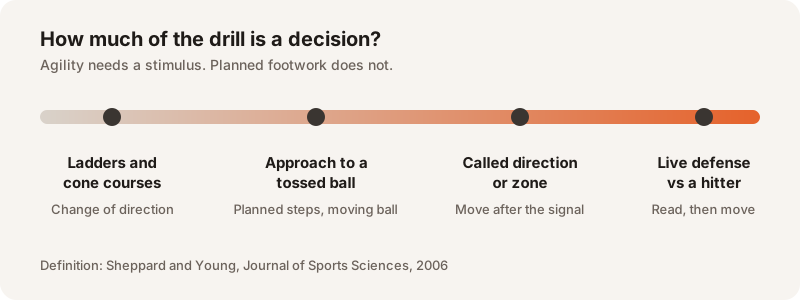
These two terms sound alike:
In a study of 76 trained athletes, being quick at a planned movement didn't mean being quick at the same movement done in response to a light. The two behaved like separate skills[1], so you need to train both.
Most changes of direction in volleyball happen within 3 to 5 meters[2], and many of them are sideways or backward over just 1 or 2 meters. Use short drills, lots of sideways and backward movement, and plenty of starts from a ready stance. Skip the 40-meter sprints.
Pick one change-of-direction test and repeat the same one every few weeks:
There's no well-established test for reading the play yet. Film one of the reaction drills from Step 5 every few weeks and compare.
Hard braking puts high, fast-rising forces through your legs, and it's a different skill from accelerating. A review of braking in team sports recommends practicing it regularly and building the leg strength to control it, especially strength while your muscles lengthen under load[3].
Keeping your knee from caving in may lower ACL risk without slowing you down, and leaning toward your next direction helps with both. Very narrow foot placement and very deep, soft landings can cost speed, so don't overdo either one[4].
Drills to use: sprint 3 meters and stop in a balanced stance, shuffle 2 steps and stick, then progress to stop-and-go (stop, then explode in a new direction).
These movements show up in almost every rally:
Middles and outsides also need to move along the net fast. Use a step-close (side-step, then bring your feet together) for short distances and a crossover (open, cross over, and plant) for longer ones.
Practice every pattern in both directions. Most players are faster one way, so find your slower side and give it extra reps. On the block, reach straight up and land on two feet with your knees bent. The plyometrics guide explains why leaning sideways strains the knee.
Once your footwork is clean, make it reactive:
Across 28 studies, mostly in soccer and basketball, agility training improved reaction-based agility. The best results came from programs lasting 7 to 8 weeks, with sessions of about 20 to 25 minutes. The authors recommend using people as cues where you can, because in a game you react to players, not lights[5].
Train reads when you're fresh. In volleyball players, physical fatigue slowed jumps and agility times, and mental fatigue slowed reactions[6].
Do agility after your warm-up and before lifting or conditioning. The warm-up guide has a routine that fits.
| Day | Session (about 20 minutes) |
|---|---|
| Mon | Braking and patterns: braking drills 4 x 3, drop steps and hip turns 3 x 3 each way, with a cue |
| Wed | Block footwork: step-close and crossover 4 x 3 each way, then with a coach pointing |
| Fri | Live reads: coach tips and tosses, 2-on-1 defense drills, short sets with full rest |
Rest 30 to 60 seconds between reps. Every rep should be full speed, and when you start slowing down, stop.
For the repeated efforts a long rally demands, pair this with conditioning.