Loading...
Conditioning
Rallies last about 5 seconds with about 30 seconds between them. Train short bursts, small-sided games, and a quick first step.
Rallies last about 5 seconds with about 30 seconds between them. Train short bursts, small-sided games, and a quick first step.
Volleyball is a few seconds of all-out effort followed by a short rest, repeated for an hour or more. Being fit for that means quicker transitions, higher jumps late in a set, and faster recovery between rallies. The training looks a lot more like volleyball than like running laps.
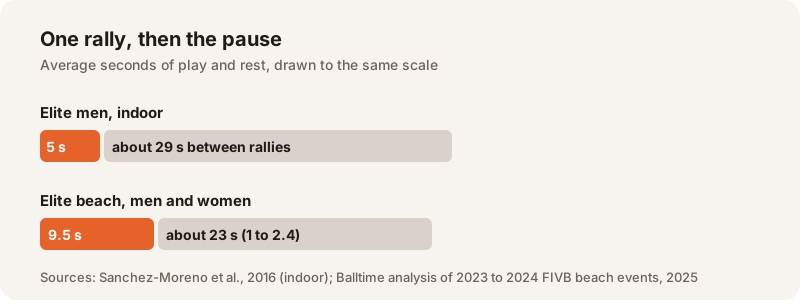
Across more than 16,000 rallies in elite men's volleyball, the average rally lasted about 5 seconds, with about 29 seconds before the next one[1]. Beach rallies run longer, about 9.5 seconds on average[2]. Some rallies stretch to 40 seconds, and a match can last around 100 minutes[3].
Two energy systems do most of the work. One fuels short, explosive efforts like a jump, a dive, or a first step. The aerobic system is the slower, steady one that keeps you going across a long match. Long scramble rallies also draw on a third system that covers hard efforts lasting more than a few seconds.
The 30-15 Intermittent Fitness Test is a good option. You run shuttles for 30 seconds and walk for 15, following a timed audio track, and the pace rises every stage. It starts at 8 km/h and goes up by 0.5 km/h each stage. The test ends when you miss the target zone three times in a row, and your score is the speed of the last stage you completed.
If your coach uses a volleyball-specific endurance test instead, that works too. Use the same test every time, at the start and end of each training block.
In a six-week trial, college volleyball players did 11 minutes of 15 seconds hard and 15 seconds of rest, three times a week. Both groups improved their aerobic fitness, sprint speed, change of direction, and jump height. The group that ran its intervals improved sprint speed more. The group that did drop jumps instead improved jump height more, but at 198 drop jumps per session[4]. That's a lot of extra jumping on top of practice, so run or bike your intervals.
Small-sided games are volleyball with fewer players, often on a narrower court. You touch the ball more and work harder. In youth players, 2-on-2 on a half-width court pushed heart rates to about 83% of max, compared with 77% for 3-on-3 and 72% for regular 6-on-6[5].
Play 2-on-2 or 3-on-3: four 5-minute games with 1 minute of rest between them, and keep score. Games build fitness, while coached drills do more for skill, so use both.
Most changes of direction in volleyball happen within 3 to 5 meters[6]. For outside and opposite hitters in elite women's matches, most speed-ups and slow-downs were sideways or backward over just 1 to 2 meters. Long sprints don't match that, so train these instead:
Add a drill that matches your position. Hitters can do a block jump, retreat 4 meters, approach, and spike jump. Liberos can shuffle 3 meters, sprint forward 3 meters, dive and roll, then backpedal. Do agility work 2 or 3 days a week, never on back-to-back days. The agility guide has the full progression.
| Day | Session | What to do |
|---|---|---|
| Mon | Intervals | Run or bike 15 sec hard / 15 sec easy for 11 minutes |
| Tue | Agility + games | Drop steps, shuffles, hip turns. Then 2-on-2 games, 4 x 5 min, 1 min rest |
| Wed | Easy day | Easy bike or row, mobility |
| Thu | Intervals | Same as Monday |
| Fri | Agility + position drills | Your position's repeat-effort drill, short sets with full focus |
| Sat/Sun | Rest or open gym | Pickup games count |
Fitness holds up well when you cut the volume, as long as the intensity stays high. In general fitness studies, endurance held for up to 15 weeks on as few as 2 sessions a week[7].
Pair this with strength training so your jumps hold up late in matches.